
A city map works on a wall because the place is yours — the city you grew up in, met in or moved to. These notes use the themes, frames and sizes of Thikana by TRIPPAL, and the same ideas hold for any framed print.
1. Match the theme to the room
Pick the theme by the room, not by the city. Find one colour the room already has — a rug, a cushion, wood or brass — and choose the theme that carries it.
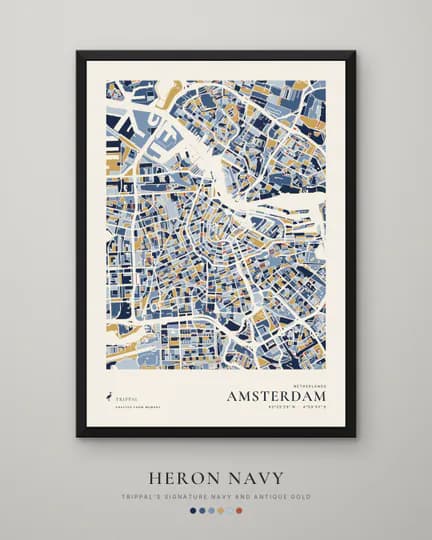
Heron Navy
TRIPPAL’s signature navy and antique gold · Daylight Collection
Cream or white walls with brass, cane or warm wood. The safe choice when you do not know the room.
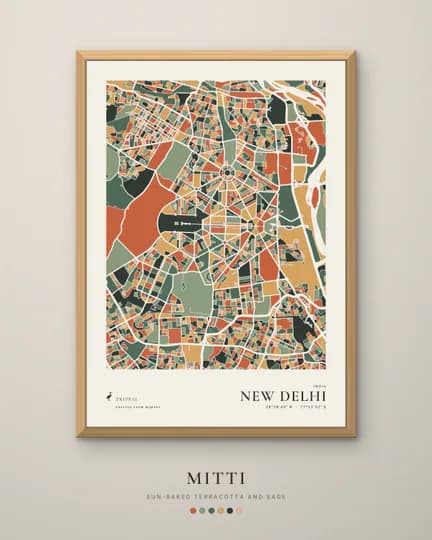
Mitti
Sun-baked terracotta and sage · Daylight Collection
Warm neutrals, terracotta pots, plants and natural fibres.
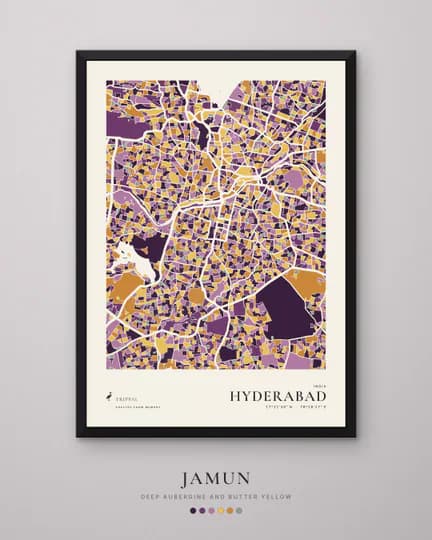
Jamun
Deep aubergine and butter yellow · Daylight Collection
A plain, bright room that needs one bold colour, or an accent wall in a deep tone.
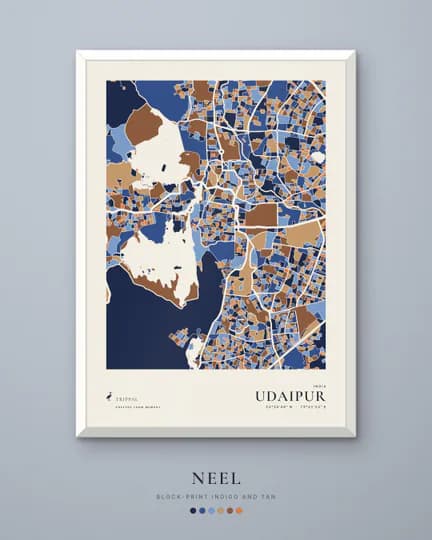
Neel
Block-print indigo and tan · Daylight Collection
Blue-and-white rooms, block-print textiles and light wood.
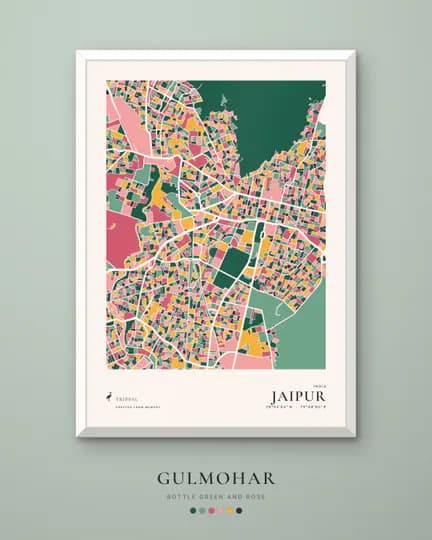
Gulmohar
Bottle green and rose · Daylight Collection
Green walls, rattan and botanical prints; it softens a bedroom.
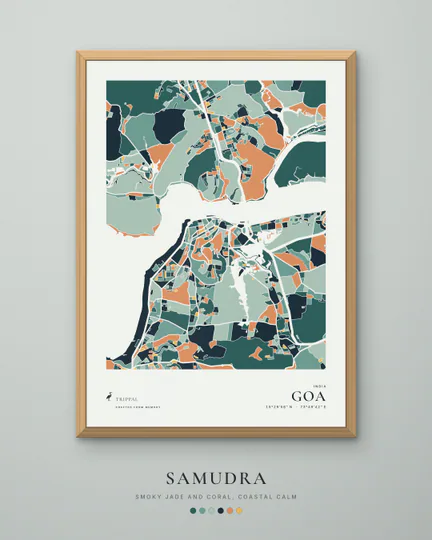
Samudra
Smoky jade and coral, coastal calm · Daylight Collection
Airy rooms with light wood and white walls, especially near the coast.
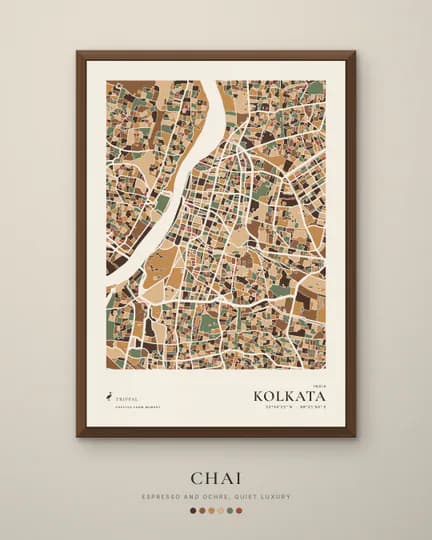
Chai
Espresso and ochre, quiet luxury · Daylight Collection
A study or living room with dark wood, leather and lamp light.
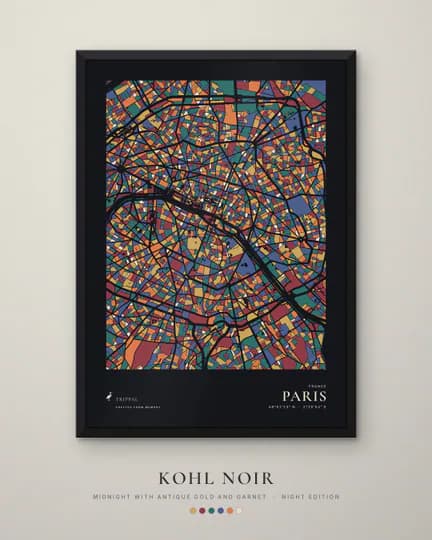
Kohl Noir
Midnight with antique gold and garnet · Night Edition
A dark painted wall or a dining room that wants drama.
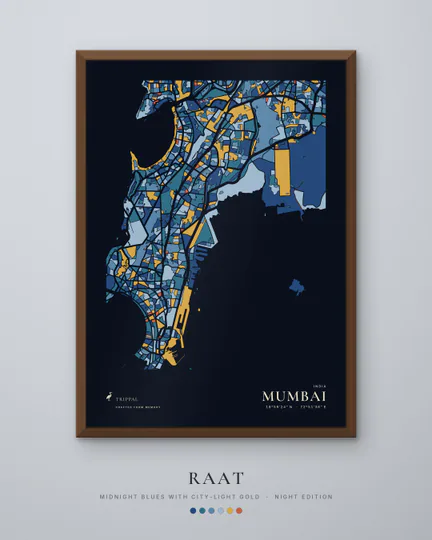
Raat
Midnight blues with city-light gold · Night Edition
A bedroom or a navy wall: city lights on a midnight ground.
2. Choose the frame for the wall
- Wooden Black — Sharpest contrast on a light wall, and it ties a mixed gallery wall together.
- Wooden White — Quiet on a white or pale wall; the map does the talking.
- Wooden Raw — Warm and natural beside wooden furniture, cane and plants.
3. Size it for the wall
City map frames come in Standard (9.5 × 12 inches) and Large (11 × 16 inches).
- Over furniture, a picture (or a group of pictures) about two-thirds the width of the piece below it looks settled. One small frame over a wide sofa looks lost; use a pair or a group instead.
- Hang the centre of the artwork at roughly eye level — around 145 to 150 cm from the floor — and lower it when it sits above a sofa or a desk, leaving a hand’s width of wall between them.
- Small walls, shelves and desks suit the smaller size; a single focal piece on an open wall suits the larger one.
4. Pair it with posters
- Let the city map lead and choose posters that share one of its colours.
- Keep one frame colour across the set, or two at most.
- Mix subjects freely — a city, a film, a team — and keep the spacing even so the wall still reads as one group.
Browse posters or see both together in wall art & home decor.
5. Plan a gallery wall
- Lay the frames out on the floor, or tape paper cut-outs of each size to the wall, before you drill.
- Keep the gaps between frames the same, about 5 to 8 cm.
- Line up one edge — the tops, the bottoms or a centre line — so the group has a spine.
- Put the largest piece (often the city map) slightly off-centre at eye level and build around it.
Design your city map
Choose the city, the theme, the frame and the size. You approve the artwork before it is printed.
Create your city map frame →